How Meaning Changes Inside Us
Every story we encounter arrives as an external offering — a tale told, a line read, a memory shared, a myth passed down. Yet the moment it enters us, it begins to reshape itself. It adjusts to the inner frameworks we’ve inherited, moulds around the ideologies we were raised within, and adapts to the landscapes our imagination knows best. Stories don’t remain fixed; they evolve quietly inside each listener, accommodating themselves to new minds in ways the original teller could never foresee.
We often speak of stories as if they are stable artefacts — fixed narratives preserved across generations. But stories are not stone. They are water. They flow through time, through culture, through language, through imagination, and through the private chambers of each individual mind. And in that journey, they change.
Sometimes the change is subtle. Sometimes it is profound. Sometimes it is so complete that the story we “know” bears little resemblance to the story that was first told.
The Myth We Think We Know
Take the Trojan Horse — one of the most famous stories in Western mythology. Most of us grew up with the image: a giant wooden horse, hollow inside, wheeled to the gates of Troy, accepted as a gift, and used as a clever trick to end a ten‑year war.
But the deeper you look, the more the story dissolves.
The earliest Greek sources don’t describe a wooden horse at all. The detailed horse narrative comes centuries later, from Virgil — a Roman poet writing long after the myth had already evolved. Some scholars argue the “horse” may have been a metaphor for an earthquake, or a mistranslated siege engine, or even a ship called a “sea‑horse.”
The story changed. Not because someone lied — but because someone interpreted.
And then someone else interpreted that interpretation. And then someone else inherited that version. And eventually, the world carried a story that may never have existed in the form we imagine.
This is how myth evolves: not through deception, but through interpretation layered upon interpretation, each shaped by the ideologies, languages, and imaginations of its time.
I learned this lesson long before I ever studied mythology.
It happened on a small bridge in Ireland.
The Yeats Moment
I studied Yeats at university. I wrote essays on his poetry, analysed his imagery, and believed I understood the essence of what he meant — the sound of water, the hush of leaves, the quiet presence of a country bridge. And in many ways, I did understand him.
But understanding a poem is not the same as standing inside its landscape.
Years later, I travelled to Ireland and sought out the place behind the poem. I found the house. I stood on the bridge. I walked through the “forest.”
And the experience was nothing like the version I had carried.
The bridge was not a grand arch over a wide river. It was simply the flat road passing over a narrow stream — a single‑lane width of water, pressed right up against the house. You could hear the water exactly as Yeats described, but the physical proportions were intimate, not expansive. The “forest” was not a deep woodland; it was a small cluster of trees, perhaps twenty‑five metres at its deepest. The house itself sat almost flush with the road, no sweeping front area, no dramatic approach — just a quiet, modest dwelling beside a gentle run of water.
Yeats had been accurate. My imagination had not.
My interpretation had been shaped by the cultural ideologies I carried — the Australian sense of space, the vastness of my internal landscapes, the scale I unconsciously assumed when reading the word “forest” or “bridge.” The poem had moulded itself to the world I knew, not the world Yeats lived in.
And in that moment, I realised how profoundly stories reshape themselves inside us — not because we misunderstand them, but because we translate them through the frameworks we were raised within.
Interpretation vs. Preservation
Some cultures recognise how fragile stories are — how easily they shift, distort, and multiply. This is why certain traditions forbid reinterpretation.
In Islamic scholarship, for example, the Qur’an is not to be individually re‑imagined or personally “interpreted” in the way Western literature often is. The goal is preservation — protecting the original meaning from the distortions that arise when each person reshapes the story inside their own ideological frameworks.
But even with strict preservation, stories still evolve. Not in their text — but in the minds of those who read them.
Because no matter how carefully a story is guarded, the listener’s inner world is always part of the equation.
And sometimes, the limits of language itself shape interpretation long before ideology even enters the picture.
When Cook’s crew first encountered the kangaroo in 1770, they described it using the closest comparisons available to them — “jumped like a hare or a dear,” and in other accounts, “like a rat.” Not because the kangaroo was any of these animals, but because their vocabulary had no established category for a creature that stood upright, hopped, and carried its young in a pouch.
Their descriptions were comparative, not definitive — an attempt to map an unfamiliar reality onto familiar words.
This is how interpretation begins: with the language we have, the meanings those words carry at the time, and the frameworks we unconsciously use to bridge the gap between the known and the unknown.
As meanings evolve, interpretations evolve with them. And the contrasts we draw — between the familiar and the unfamiliar — often create scenes and assumptions that do not fully reflect the reality being described.
Even the most earnest description can be reshaped by the boundaries of the listener’s world.
The Gatekeepers of Story
Across many literary traditions, certain collectors are treated as the “official” guardians of myth.
The Grimm Brothers, for example, travelled through parts of Europe gathering folktales with all their variations, selecting the versions they preferred, and shaping them according to the ideologies of their time — morality, nationalism, Christianity, gender roles. Their work was not so much preservation as it was curation.
Interpretation.
Editing.
And once those interpretations were finalised in print — structured, polished, and published as the “best” versions from their perspective — the world inherited them as though they were the only versions, the originals.
Years ago, a lecturer dismissed my use of Women Who Run With the Wolves as “invalid” because it wasn’t a traditional academic source. But I had lived that book. It got into the bones of everything — right into the heart and soul of the elements in each story’s message. And I had experienced its truths. Its stories resonated with my inner world in ways the Grimm versions never had.
And that taught me something essential:
A story’s authenticity is not determined by its collector.
It is determined by its resonance.
The Inner Story
Across countless cultures, stories have been carried not in books but in voices.
African oral traditions, Aboriginal songlines, and the tales of the South Pacific islands were never meant to be fixed in ink.
They were meant to be lived — spoken, remembered, repeated, and reshaped across generations.
Their aims were simple and profound: to pass down history, to teach morality, to guide the young, to preserve identity, and to keep the wisdom of ancestors alive.
Some stories were cautionary.
Some were instructive.
Some were simply mirrors held up to human nature.
And while many of these tales appear straightforward on the surface, their deeper meanings often reveal themselves only through resonance — when a listener’s inner world aligns with the story’s bones.
A simple tale can become a lifelong compass.
A small moral can become a personal revelation.
A quiet narrative can become a teacher in a completely different reality.
Of course, not every story survives intact.
Some lose details as they travel.
Some shed their original context.
Some become colder, less intuitive, less instructive — their magic thinned by time or misinterpretation.
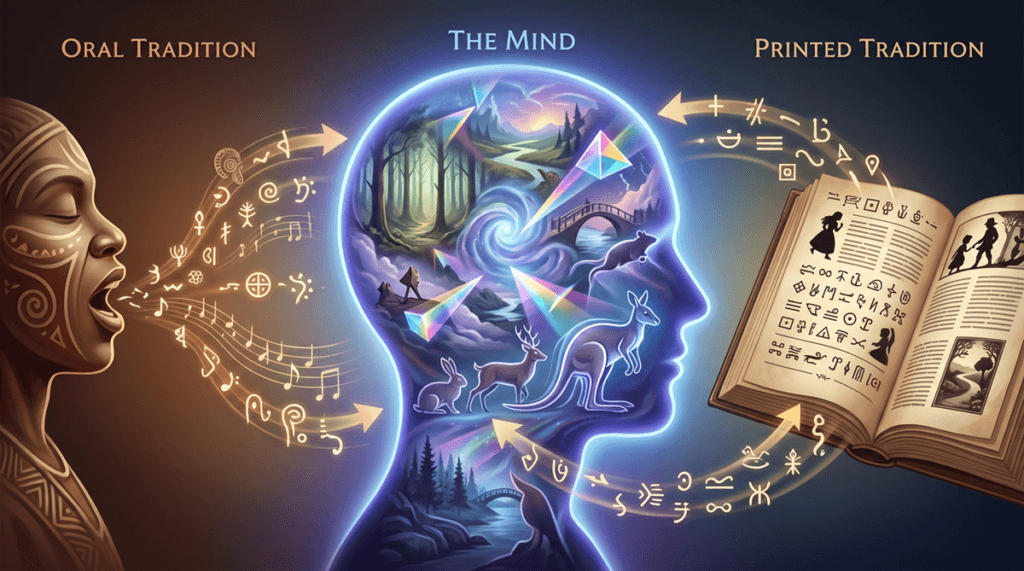
Because every story we encounter becomes two stories:
- the one that was told
- and the one that forms within us
The second is shaped by our cultural ideologies, our inherited frameworks, our imagination, our lived experience, and the emotional landscapes we carry. It is never identical to the first — and sometimes, it diverges so far that the original meaning becomes almost unrecognisable.
Yet even when the surface shifts, the deeper essence — the bones, the heart, the soul of the story — often continues to travel, teaching across time, place, and circumstance.
Stories evolve inside us because we evolve.
And the story we carry becomes part of who we are — not because it was told perfectly, but because it reshaped itself to fit the contours of our inner world.
In the end…
Stories are living things.
They breathe.
They shift.
They adapt.
They accommodate themselves to new minds, new cultures, new eras, and new imaginations.
Some stories lose pieces along the way.
Some gain new layers.
Some fracture into variations.
Some distort into shadows of their former selves.
But many still carry their original light — refracted through the unique prism of each human life.
The story you carry is not the story someone else carries.
And that is the quiet magic of narrative: a story can change shape a hundred times, yet still carry the truth that was placed in it long ago.