Overwhelm rarely arrives with fanfare. It doesn’t crash through the door or announce itself with a dramatic collapse. More often, it begins quietly — in the small corners of life, in the places we stop tending, in the subtle shifts we barely notice until they’ve already taken root. It’s the slow spill of everyday life slipping out of our hands, one overlooked detail at a time.

The Quiet Onset: When Life Starts to Slip
Sometimes the earliest signs of overwhelm are right in front of us. You notice your house getting messy — dishes sitting a little longer than usual, rubbish that really should go out, the green bin attracting bugs because you haven’t made it to the curb. Clothes gather in corners, floors wait for a sweep or a vacuum, plants look like they need trimming or a little TLC. You catch sight of a chipped fingernail or dirt under your nails and think, I should really find that nail file.
As it worsens, you realise you’ve forgotten to brush your hair. Maybe even shower. Meals become quick fixes instead of real food. You’re functioning, but not well — and you know it.
These aren’t failures. They’re clues. They’re the visible evidence of something internal beginning to slip. When enough of these small things accumulate — and everyone has their own tolerance level — you feel that subtle sense of having “let go” of personal order.
Some people live in a certain state of chaos even at the best of times, accepting the impossibility of ever fully catching up. Organisation becomes a negotiation between priorities: family, partners, work, friends — each carrying their own needs that drift in like clouds. At first, they’re light. Manageable. But then the clouds thicken, darken, and the list of things to do expands faster than you can cross items off. The personal organisation zone becomes a distant dream.
Sometimes it’s not even the mess. Sometimes it’s habits, routines, or distractions that pull you away from the things you want to do. You take a “time out” and dive into a preferred activity just to feel better for a moment — but the backlog remains, quietly waiting in the background.
The point is: overwhelm leaves clues. You can literally see them building and accumulating. Many of us accept these clues as part of life — the “I’ll get to it one day” pile. We push them into the shadows.
Think of it like a stain. How big does the stain need to be before you decide you can’t wear that shirt anymore? You tell yourself, It’s my favourite shirt… I’ll just wear it around the house. A stain remover might help — but that requires effort you don’t have.
This is how overwhelm begins: quietly, subtly, almost politely.
When the Storm Builds
But overwhelm doesn’t always stay subtle. Like storms, it can build slowly or hit suddenly.
Sometimes you’re dumped with something outside your control — a demand, a crisis, a change — that doesn’t fit with the plans you were already squeezing into your schedule. You were barely holding things together, and now something new arrives, tipping the balance.
Other times, it’s the slow build. One more thing added to an already full pile. One more responsibility. One more expectation. One more emotional weight.
Eventually, something becomes the proverbial cherry on top — the tiny excess that makes everything feel unstable. You imagine your world beginning to slide, like melting ice‑cream tipping off its cone. And somewhere inside, you feel yourself doing the same.
This is the onset of overwhelm: the moment the internal load becomes heavier than your capacity to hold it.
The Emotional Texture of Overwhelm
Emotionally, overwhelm doesn’t always look dramatic. Often, it feels like:
- Resigned exhaustion — still moving, still functioning, but stretched thin.
- Hypervigilance without clarity — alert, but unsure what you’re alert to.
- Trying to cope while already overloaded — the effort outweighs the energy.
- Chaos that feels familiar but unmanageable — you’ve been here before, but this time it’s harder.
- A sour taste — the emotional residue of dealing with too much for too long.
- Pressure building even when nothing dramatic is happening — the weight is internal, not external.
- An internal world becoming cluttered — mirroring the external clutter around you.
Overwhelm isn’t panic. It’s compression.
It’s the slow tightening of your emotional space until there’s barely room to breathe.
The Cognitive Overload Layer
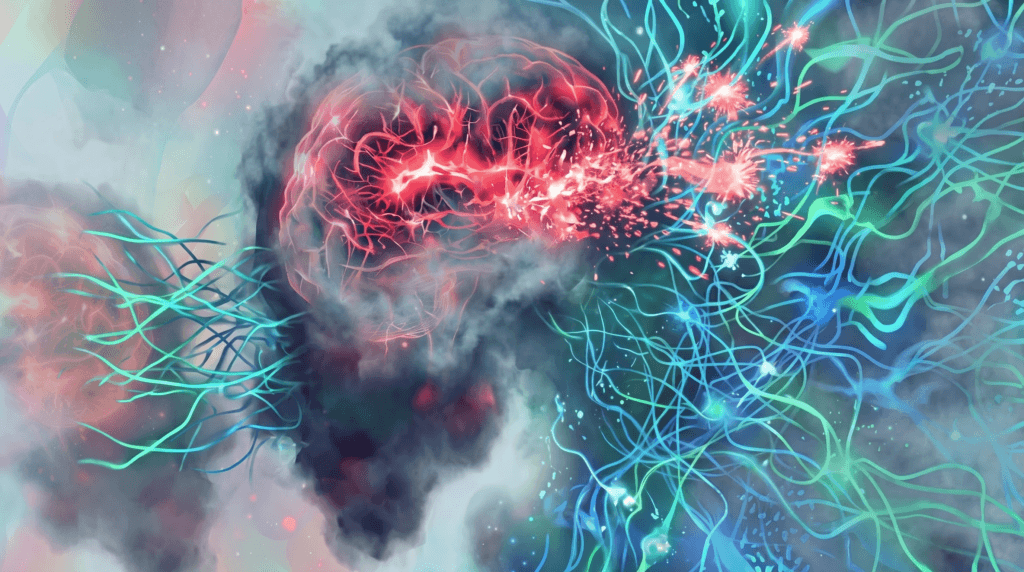
Then comes the mental layer — the part where thinking itself begins to fray.
You lose the ability to process complexity cleanly. Thoughts stop landing. You feel rushed even when no one is rushing you. You can’t hold multiple threads at once. You feel like you’re failing at something, even when you’re not. You become aware of too many inputs at once — visual, emotional, conceptual.
It’s like sitting in front of a visually cluttered questionnaire — too many boxes, too many questions, too much noise. The page is chaotic, your mind is chaotic, and your emotions follow suit.
This is cognitive overload. It’s not dramatic. It’s destabilising.
Behavioural Signs: What Overwhelm Looks Like on the Outside
Overwhelm often shows itself in behaviour long before it shows itself in emotion. One of the earliest signs is difficulty starting tasks that normally feel manageable. You know what needs doing — the dishes, the email, the laundry, the phone call — but your body simply won’t initiate the action. This isn’t laziness. It’s your system quietly signalling that it’s already carrying too much.
From here, two closely related patterns often appear: avoidance and procrastination. They look similar from the outside, but inside they feel different. Avoidance is the instinctive pull away from something that feels too heavy to face. Procrastination is the attempt to delay what you intend to do, hoping you’ll feel more capable later. Both are forms of self‑protection. Both are signs that your internal load has exceeded your available bandwidth.
Another behavioural sign is the need for micro‑steps. When overwhelm sets in, even simple tasks feel too large to hold in one piece. You break things down into tiny fragments — “open the document,” “write one sentence,” “put one item in the bin.” These micro‑steps aren’t a weakness; they’re a way of bypassing the overwhelm threshold so your system can keep moving without collapsing.
Then there’s the feeling of being off‑path. This can show up in subtle ways — a dazy moment, a misstep, a small accident that snaps your attention back to your body. Maybe you half‑slip down the stairs, or bump into something you normally navigate around easily. It’s not clumsiness. It’s your body signalling that your internal balance is off, that your mind is overloaded, that you’re moving faster than your clarity can support.
And finally, there’s decision friction — one of the most telling signs of overwhelm. Choices that should be simple suddenly feel foggy. You can’t see the options clearly. Priorities blur. The mind wobbles between yes and no, unable to land. It’s the mist, the fog, the dirty‑glasses syndrome: you’re looking at your life, but you can’t quite see it well enough to respond. This isn’t indecision — it’s cognitive overload.
These behaviours aren’t failures. They’re signals. They’re the body’s way of saying, “Slow down. Something needs attention.”
The Internal Narrative: The Voice That Makes It Heavier
Inside overwhelm, the inner voice often turns sharp:
- “I should be able to handle this.”
- “Why is this suddenly too much?”
- “I’m tired but I need to keep going.”
- “Something feels wrong but I can’t name it.”
- “I’m stretched thin.”
- “I’m functioning, but not well.”
This self‑talk doesn’t cause overwhelm — but it intensifies it.
The Deeper Purpose of Overwhelm
Before the full weight of overwhelm settles in, anxiety often rises first — that sharp, breath‑catching sense that everything is happening too fast and you can’t keep up. It’s the moment where panic whispers that you’re going to miss something important, lose something meaningful, or fail at something you care about.
You feel helpless, vulnerable, and pressed for time, even when nothing urgent is actually happening. This anxiety isn’t a flaw; it’s an early warning signal. It’s the body’s way of saying, “Pause. Breathe. Something here needs gentleness.”
Sometimes overwhelm blocks a path you desperately wanted — but that path was never truly yours. No matter how much you desired it, it would have taken you somewhere you didn’t want to be in the long run.
Overwhelm redirects. It protects. It reveals. It asks you to pause.
Here’s the part most people miss:
Overwhelm is not a failure. It’s a signal.
It’s the moment where your internal world becomes visible. It’s the threshold before change. It’s the place where old patterns begin to crack. It’s the moment that reveals what you’ve been ignoring.
A Gentle Way Forward
And if you feel anxiety rising alongside overwhelm — that tightening in the chest, that sense of urgency or panic — let that be your cue to stop for a moment. Take a breath. Slow your pace. Refocus. Anxiety is not the enemy; it’s simply the body trying to protect you from moving too fast for your own clarity.
Stop. Breathe. Take baby-step by baby-step.
You are allowed to pause long enough to find your footing again.
So, chin up. Step by step. Allow what is. Give yourself the priority you deserve.
When you do, the “end of the world” flashes of overwhelm begin to fall away. The storm settles. The clouds thin. And slowly, you return to yourself — clearer, steadier, and more aware of what truly matters.