When the World Quietly Widens
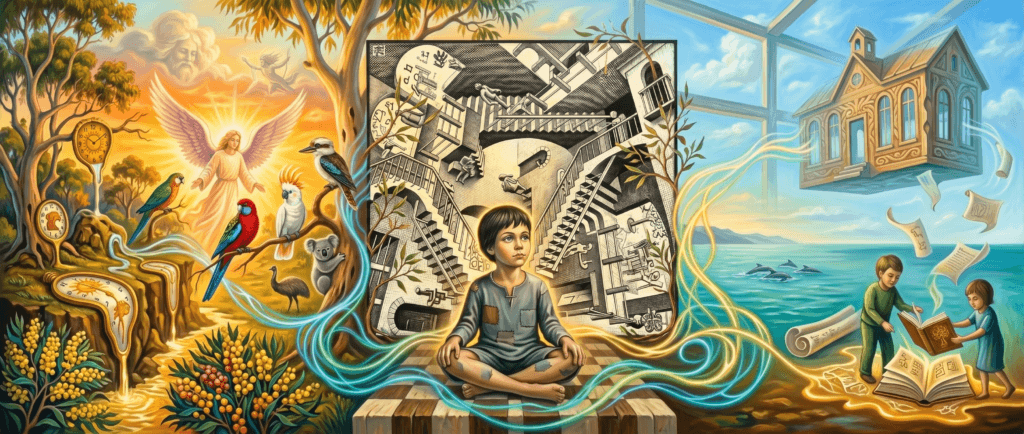
There comes a point in all our lives — though we rarely recognise it at the time — when the world begins to widen. Not dramatically, not with ceremony, but quietly. A neighbour’s laughter drifting across a fence. A first friend whose home feels different to ours. A classroom’s hum. A playground’s unspoken rules. These are the early thresholds where we first stepped into the shaping influence of community — sometimes gentle, sometimes harsh, but always formative.
We don’t remember it as a single moment.
We remember it as impressions — sensations, fragments, atmospheres.
A rule we didn’t know until we broke it.
A story told by someone who wasn’t part of our family.
A moment of belonging.
A moment of not.
By the time we reach what many traditions call the age of reason — somewhere around seven — we have already absorbed more than we realise. Not consciously. Not analytically. But through immersion. Through repetition. Through the emotional weather of the world around us.
Identity at this stage is not something we construct.
It is something we inhale.
We absorb the rhythms of our neighbourhoods, the tone of our early classrooms, the expectations of the adults who cross our path, the unwritten rules of the playground, the stories whispered at bedtime, the myths embedded in the tales we loved without understanding why.
These early community experiences become the second storyteller in our lives — the first voice that comes from outside the family, shaping us in ways we might only recognise decades later.
And whether we remember the details or only the emotional imprint, these early social landscapes leave marks that follow us far into adulthood.
The Village Atmosphere and the Shaping of Self
When we look back, most of us can sense the moment our world began to include people who were not part of our family’s inner orbit. A neighbour who spoke differently. A relative whose expectations felt unfamiliar. A teacher whose approval mattered in a new way. A circle of peers whose unspoken rules we learned to read — sometimes adapting to them, sometimes resisting them, sometimes quietly choosing our own place within them.
These early community circles — however small or simple — became the first places where we learned that identity is not formed in isolation. It is shaped in relation.
Communities teach through atmosphere as much as through action.
We absorb what is praised.
We notice what is ignored.
We feel what is quietly disapproved of.
Not always consciously. Not always with the language for what we were doing — but often with far more awareness than adults give children credit for.
Some of us grew up in neighbourhoods rich with diversity — where languages, customs, and ways of being overlapped like colours in a mosaic. Others grew up in places where sameness was the norm, and difference was rare enough to stand out sharply. Whatever the influence — whether familiar, chaotic, nurturing, or unpredictable — these early environments taught us something essential about belonging, difference, and the invisible boundaries of community life.
This is where the earliest layers of social identity begin to form.
Not the deep cultural narratives of adolescence — those come later — but the first sense of “us.”
The local “us.”
The immediate “us.”
The “us” defined by proximity, routine, and shared spaces.
We echoed the phrases we heard.
We mirrored the behaviours that earned approval.
We learned the unspoken rules that made life smoother.
We absorbed the emotional tone of the people around us.
These early community stories didn’t replace the family’s influence — they expanded it.
They added texture, contrast, and complexity.
They introduced us to the idea that identity is shaped in widening circles, each one adding its own imprint.
And whether we grew up in a bustling neighbourhood or a quiet rural pocket, the village — whatever form it took — left its mark.
The First Stories We Absorb — Fairy Tales, Fables and Cultural Scripts
If we trace our earliest memories of story, many of them come not from books we chose ourselves, but from the tales handed to us by the adults around us. Bedtime stories. Fairy tales. Fables told in classrooms. Stories whispered by older cousins. Tales of times past. Legends shared at community gatherings.
We listened, we repeated, we memorised — sometimes as part of religious tradition, sometimes as part of schoolwork, sometimes simply because the adults around us asked us to. Whether it was reciting verses, learning the names of ancient figures, chanting lines from sacred texts, or repeating stories told in classrooms and gatherings, we took these narratives in long before we understood their depth. They settled into us quietly, shaping meaning in ways we only recognise much later.
These tales carried archetypes long before we had language for archetypes.
They offered symbolic maps long before we could read maps.
They prepared the psyche for a world that was larger, more complex, and more unpredictable than the safety of home.
They brought:
- characters
- adventures
- warnings
- mysteries
- heroes
- villains
- miracles
- consequences
- archetypes
These were not just stories.
They were scripts — early cultural frameworks that shaped how we understood courage, danger, kindness, cleverness, obedience, rebellion, and the nature of the world itself.
A brave hero taught us what “good” looked like.
A trickster taught us the power of wit.
A villain taught us what to fear.
A lost child taught us the cost of wandering too far.
A magical or angelic helper taught us that assistance sometimes comes from unexpected places.
They were often stories from long ago in faraway places — often of histories or happenings long gone — that only later we might realise they were shaping our worldview, our moral compass, our sense of right and wrong, our understanding of power, justice, kindness, danger, and destiny.
And whether our childhood stories came from oral traditions, Biblical stories, Quranic stories, Hindu epics, Buddhist parables or other religious teachings, cultural myths, from history or the imaginative improvisations of the adults around us, they all served the same purpose:
They shaped the early architecture of meaning.
They taught us how to interpret the world.
They taught us what mattered.
They taught us what to expect.
They taught us who we might become.
Even now, as adults, we can feel the echoes of those early tales — the ones that frightened us, comforted us, or stayed with us for reasons we still can’t fully explain.
These stories were our first cultural teachers.
And they left deeper imprints than we ever realised at the time.
The First Roles We Stepped Into
When we look back on our earliest social worlds, most of us can still feel the atmosphere of those first shared spaces — the schoolyard, the early classroom, the places where we first encountered peers who were neither family nor neighbours, but something entirely new.
These were the first small societies we entered.
Unstructured, yet strangely ordered.
Chaotic, yet governed by rules no adult ever explained.
And in these spaces, we began trying on roles — sometimes instinctively, sometimes deliberately, sometimes with more awareness than anyone realised.
Some of us discovered we were the quiet observer.
Some became the helper.
Some found themselves cast as the leader.
Some slipped into the role of the outsider.
Some became the one who made others laugh.
Some became the one who always followed the rules.
Some became the one who always tested them.
Most of us didn’t choose our early roles — they formed around us through circumstance, temperament, and the subtle feedback of peers. But some of us, even then, sensed the story we were stepping into. We recognised the role we were being handed and quietly decided, not this time. A move to a new school, a shift in environment, a change in the social landscape — these moments offered rare chances to rewrite the script, even if we didn’t yet have the language for what we were doing.
For most, identity in these early years is something absorbed.
For a few, it is something adjusted.
Either way, the schoolyard becomes the first stage where we learn that identity is not fixed — it is responsive.
And even now, as adults, we can trace the echoes:
- the confidence we gained
- the insecurities we carried
- the masks we learned to wear
- the ways we adapted to belong
- the ways we shrank to avoid standing out
- the ways we stepped forward when something in us knew we could
The schoolyard was our first encounter with social mirrors — reflections that didn’t come from family, but from peers navigating their own forming identities.
These experiences didn’t define us, but they shaped the early scaffolding of how we understood ourselves in relation to others.
And whether we remember the details or only the emotional imprint, the schoolyard left its mark.
The Unspoken Cultures We Absorbed
Every community carries its own mythology — not in the grand, ancient sense, but in the quiet, everyday way that norms, sayings, rituals, and expectations seep into us without ever being named.
We absorbed these micro‑cultures long before we understood what culture was, or that we even had one.
Some of us grew up in places where certain phrases were repeated so often they became truth.
Some of us grew up in communities where tradition was the anchor.
Some grew up in neighbourhoods where everyone knew everyone.
Some grew up in places where privacy was the norm and silence carried its own meaning.
And woven through all of this were the stories — not just the fairy tales and fables, but the local stories, the ones that shaped our sense of what was normal, what was admirable, what was dangerous, what was expected.
These were the stories that taught us:
- “This is how we behave.”
- “This is what we value.”
- “This is who we trust.”
- “This is who we don’t.”
- “This is what people like us do.”
- “This is what people like us don’t do.”
These were the facts of life.
We absorbed it the way we absorbed the weather.
And for many of us, religious stories were part of this tapestry — not as doctrine, not as moral instruction, but simply as stories from “long ago,” stories about people who lived in a world that felt both distant and strangely familiar.
We didn’t question the truth of them.
We simply took them in — the characters, the consequences, the miracles, the warnings, the archetypes.
These micro‑cultures — whether secular, spiritual, traditional, or entirely unique to our neighbourhood — became the early architecture of worldview.
They shaped:
- what we believed was possible
- what we believed was dangerous
- what we believed was expected
- what we believed was “just the way things are”
And even now, as adults, we can feel the imprint of those early atmospheres — the subtle shaping of identity through the stories our communities lived, repeated, and embodied.
⭐The First Taste of Otherness
Somewhere in those early years, long before we had the language for it, we encountered our first taste of otherness. Not the philosophical kind — the lived kind. The moment we realised that the world had categories, preferences, and invisible lines we didn’t draw but somehow had to navigate.
It might have been a comment about how we looked.
A reaction to how we spoke.
A laugh that wasn’t friendly.
A silence that felt colder than it should have.
A rule that applied to us but not to someone else.
These moments didn’t arrive with explanations.
They arrived as sensations — sharp, confusing, unforgettable.
This is where many of us first learned that belonging wasn’t guaranteed.
That difference had a cost.
That the world had its own logic, separate from the safety of home.
Some of us responded by shrinking.
Some by adapting.
Some by masking.
Some by becoming louder, brighter, more defiant.
Some by stepping back and watching — learning the terrain before stepping into it.
And some of us — the early‑aware ones — recognised the pattern even then.
We sensed the dynamics.
We read the room.
We understood the unspoken rules faster than anyone expected.
These early encounters with otherness didn’t break us.
They sharpened us.
They taught us resilience, empathy, discernment, and the beginnings of self‑protection.
They were the first signs that identity is not just shaped by the stories we’re given — but by the stories we learn to navigate.
⭐ When Outer Voices Become Inner Narrators
At some point — often without noticing — the voices around us begin to echo inside us.
A teacher’s tone.
A neighbour’s comment.
A friend’s approval.
A peer’s criticism.
A community’s expectations.
These external impressions slowly become internal statements.
“I am…”
“I’m not…”
“I should…”
“I shouldn’t…”
“This is who I am.”
“This is who I’m allowed to be.”
We don’t choose these early narrators.
They arrive through repetition, atmosphere, and emotional impact.
And they blend with the stories from home — forming a layered, sometimes contradictory inner landscape.
This is where many of us first felt the tension between:
- belonging and authenticity
- expectation and instinct
- who we were told to be and who we sensed we were
Some of us complied.
Some resisted.
Some floated between the two.
Some learned to perform.
Some learned to hide.
Some learned to observe.
Some learned to rewrite the script — even if only internally at first.
These early internal voices become the foundation upon which later identity work is built.
They are the first drafts of the self — imperfect, inherited, absorbed, but deeply influential.
And at some point — whether in adolescence, early adulthood, or much later — we start to recognise which voices were truly ours… and which were never ours to begin with. For some, this clarity arrives early, sharp and undeniable. For others, it unfolds slowly over years. And for many, it comes in waves — moments of insight that reshape how we understand the stories we once absorbed without question.
⭐ The Village Leaves Its Mark
When we look back, it becomes clear that community — whatever shape it took — was the second storyteller in our lives. Not as intimate as family, not as vast as culture, but profoundly formative in its own quiet way.
These early social landscapes taught us:
- how to belong
- how to navigate difference
- how to read people
- how to interpret unspoken rules
- how to understand ourselves in relation to others
They shaped our worldview long before we had the words for worldview.
They shaped our identity long before we knew identity was something that could be shaped.
And they prepared us — gently or harshly — for the next widening of the world:
the cultural stories, the national narratives, the global influences, the digital mythologies that would come later.
The village doesn’t disappear as we grow.
Its stories simply become part of the foundation — the quiet architecture beneath everything we build afterward.
And whenever we look back — whether in youth, adulthood, or any moment of clarity along the way — we can begin to see the truth: identity is shaped in widening rings.
Family.
Community.
Culture.
World.
Self.
And each ring leaves its mark — not to confine us, but to give us the raw material from which we eventually craft who we choose to become.