How identity begins long before we speak our first word
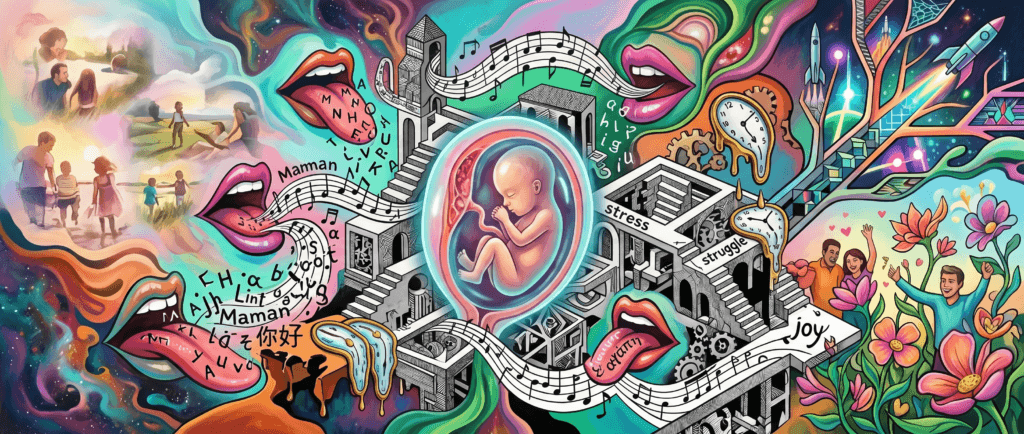
Before We Take Our First Breath
Identity doesn’t begin with language. It begins with atmosphere.
Long before we learn to form thoughts, we are already absorbing the emotional weather of the world we’re entering. The womb is not a blank space — it is a chamber filled with tone, rhythm, tension, calm, and the unspoken stories of the family we are about to join. Some say we choose these families for the lessons they hold; others say we arrive into a narrative already in motion. Either way, the imprinting begins before breath.
A mother’s heartbeat becomes the first drum of belonging. A father’s voice becomes the first vibration of expectation. The household’s emotional climate becomes the first map of “what life feels like.”
These early impressions may not be conscious, but they are formative. They create the first architecture of identity — the scaffolding upon which later stories will attach. We are shaped by the stories spoken around us, yes, but also by the ones whispered through silence, stress, joy, and the subtle choreography of family life.
Before we ever say “I am,” the world has already begun to answer on our behalf.
Family as the First Culture
Family is our first society — the original tribe whose customs, rhythms, and unspoken rules become the template for how we understand the world. It is here that we learn what is normal, what is dangerous, what is expected, and what is possible.
Children don’t learn identity through explanation. They learn it through observation.
Who speaks and who stays quiet. Who is praised and who is corrected. Who carries the emotional load and who is allowed to fall apart. Who is the centre of the story and who becomes the supporting character.
And then come the identity scripts — those deceptively simple labels that land like seeds:
- “He’s the daredevil.”
- “She’s the one we worry about.”
- “You’re the responsible one.”
- “He’s the emotional one.”
- “She’s the difficult one.”
These aren’t just comments. They are assignments.
Roles handed out before we understand what roles are. Expectations wrapped in affection, anxiety, or habit. Narratives that begin to shape how we move, how we speak, how we imagine ourselves.
Family writes the prologue of our lives long before we find our own voice.
The Unspoken Stories
Not every story is told aloud. Some are transmitted through silence — the kind that stretches across a room like a shadow.
A family that avoids conflict teaches that confrontation is dangerous. A family that never speaks of feelings teaches that vulnerability is unwelcome. A family that tiptoes around old wounds teaches that pain must be hidden, not healed.
Children absorb these lessons without needing a single word. Emotional atmospheres imprint themselves into implicit memory — the kind of memory that lives in the body, not the mind.
We learn:
- how much space we’re allowed to take
- which emotions are acceptable
- which truths must be swallowed
- which fears are inherited rather than earned
These unspoken stories often carry the weight of generations. A grandmother’s unprocessed grief becomes a mother’s quiet tension becomes a child’s sense of unease. A grandfather’s silence becomes a father’s stoicism becomes a son’s emotional distance.
The stories we never hear are often the ones that shape us most.
The Tiny Moments That Become Lifelong Narratives
Identity doesn’t always form through grand events. Often, it crystallises in tiny, forgettable moments that echo for decades.
A careless comparison: “Why can’t you be more like…?”
A moment of shame: “Stop crying. You’re too sensitive.”
A public embarrassment that burns itself into memory.
A parent’s fear projected onto a child: “Be careful. The world is dangerous.”
These moments become the raw material of the inner narrator — the voice that whispers:
“I am too much.” “I am not enough.” “I am the one who must hold everything together.” “I am the one who always gets it wrong.”
From these seeds grow:
- phobias
- emotional blocks
- perfectionism
- self-silencing
- overachievement
- avoidance
- people pleasing
Tiny moments. Long shadows.
When we trace these shadows back to their source, we often discover that the story we’ve been living wasn’t ours to begin with.
Ancestral Echoes
Identity is not only personal — it is generational.
Families carry stories the way trees carry rings: layers of experience, trauma, resilience, and silence embedded in the grain. Some of these stories are told openly — tales of survival, migration, hardship, or triumph. Others are whispered, hinted at, or buried entirely.
But even buried stories have weight.
Unresolved trauma travels through behaviour, belief, and emotional patterning. Fear becomes caution becomes rigidity. Shame becomes secrecy becomes silence. Violence becomes anger becomes withdrawal.
Epigenetic research now echoes what myth and psychology have long known: the body remembers what the mind is never told.
Generational patterns repeat until someone becomes conscious enough to interrupt them. The moment we recognise the echo, we gain the power to change its direction.
We are not just inheritors of bloodlines. We are inheritors of unfinished stories.
The Family Myth
Every family has a myth — a central narrative that shapes its identity and binds its members together.
“We are survivors.” “We don’t trust easily.” “We always struggle.” “We are strong women.” “We don’t talk about feelings.” “We take care of our own.”
These myths act as both anchor and boundary. They offer belonging, but they also define the limits of what is acceptable.
A family that prides itself on resilience may unintentionally discourage vulnerability. A family that values achievement may overlook emotional needs. A family built on survival may fear risk, even when the danger has long passed.
These myths are powerful because they are rarely questioned. They feel like truth — not preference. Like identity — not conditioning.
But every myth has an origin. And every myth can be examined.
When we understand the story the family tells about itself, we can finally see the space where our own story begins.
When Inherited Stories Become “I Am”
At some point, the stories around us become the stories within us.
The family’s narrative becomes the inner narrator. The labels become identity. The expectations become self-imposed rules. The emotional atmosphere becomes the internal climate.
This is where inherited stories crystallise into “I am…” statements:
“I am the one who fixes things.” “I am the one who doesn’t need help.” “I am the one who must stay small.” “I am the one who keeps the peace.” “I am the one who doesn’t belong.”
These internalised scripts shape:
- relationships
- ambitions
- fears
- boundaries
- self-worth
- the choices we make
- the choices we never consider
The inner voice is not born neutral. It is born from narrative.
And once we recognise that, we can begin to separate what is inherited from what is true.
The Threshold Into the Stories We Choose
Every inherited story is a beginning, not a boundary.
When we trace the threads of our identity back to their origins — the spoken, the unspoken, the generational, the mythic — we begin to see the architecture of the self with new clarity. We see which stories shaped us, which ones protected us, which ones limited us, and which ones were never ours to carry.
This awareness is not an ending. It is a threshold.
A moment where the old narrative loosens its grip, and a new one begins to form — not from expectation, but from choice. Not from inheritance, but from intention.
Identity is not fixed. It is unfolding.
And now that you can see the roots, you can feel the branches shifting.
There are more layers to explore — more stories that shape us, more stories we outgrow, more stories waiting to be reclaimed or rewritten. But for now, it is enough to stand here, at the edge of the inherited world, with the quiet understanding that your story is no longer something that happens to you.
It is something you are learning to shape.
One layer at a time.